The state of Texas has been reported to have the second-largest economy in the United States when looking at the gross domestic product (GDP). At the end of 2021, Texas managed to have a GDP of two trillion dollars, making it one of the best and most beneficial economic climates not just in America, but in the whole world. Below are Industries Driving Economic Growth in Texas.
Industries Driving Economic Growth in Texas
Such a bustling economy is fuelled by the gargantuan efforts made by top companies that are pioneering a variety of industries in the Lone Star State. Thanks to all of the great opportunities Texas provides to new and established business owners, so many unique and innovative businesses are operating in the state, which ensures that a plethora of different business industries are creating large amounts of economic growth.
From agriculture to information technology, Texas is home to it all, and there are some key industries that have driven Texas’ economy to become what it is today.
Construction Industry
An area of work that requires hard work, dedication, and a lot of physical effort, the construction industry is one of the most crucial areas of business, especially in Texas. As Texas is constantly growing and developing, the construction industry is there to facilitate said growth through the building of houses, office spaces, retail stores, and more. With so many people making the move to Texas, there is always a need for construction work.
This industry employs over 700,000 people and it is one that does not require a plethora of tertiary education and degrees. The open nature means that the industry is free to grow quickly and swiftly, as it is in Texas.
Agriculture Industry
When it comes to agricultural commodities, Texas is one of the leading producers in the entire state. The farms there are the top producers of hay, dairy products, sheep, and horses. Alongside that, the state is very well-known for its top-quality fruits, vegetables, and grains. The entire country relies heavily on Texas, thanks to their agricultural expertise and exportation.
Contributing trillions of dollars to the United States’ GDP, the agricultural industry in Texas is continuously growing and there seems to be no end in sight as this type of business is one of the cornerstones in the entire state and country as a whole.
Hospitality Industry
Texas is a tourism hotspot, and for this reason, the state managed to employ over a million people. Thanks to this industry, job creation is at an all-time high in Texas, when with lockdown tensions easing, more peace of mind is established, and people are finally free to travel again.
Over 7 million wildlife tourists visit Texas every single year. The hospitality industry gives business opportunities to hotels, restaurants, bars, wildlife parks, and more. This industry is able to cater to the needs of som nay different business owners, making it one of the best and most well-received in the state
Information Technology (IT) Industry
The future is here and now, and it comes with so many digital advancements that allow businesses to operate both in the physical space, as well as on the internet through online markets. Businesses are also using a variety of different tech devices and applications from tablets, laptops and WiFi, to social media, websites and different online programs and functions.
Thanks to this digital revolution, the IT industry is bursting with new and innovative businesses that can help with data analytics, tech repairs, providing the best and newest equipment and more. With over 17,000 tech companies in Texas, big and small businesses are making a mark in the state, creating jobs for over 200,000 talented individuals.
Takeaway
Business is clearly booming in Texas, the state is open to entrepreneurs who belong to all walks of different unique and exciting industries that are positively contributing to the economy. If entrepreneurs are wanting to start a limited liability company (LLC) and are wondering how to form an LLC in Texas, there are so many great online resources to aid potential new business owners on their exciting journey in one of the best business states.
Also, read 7 Tips for Promoting Your Small Business Locally.
Becoming a business owner in Texas can be a liberating experience, but not without its pitfalls. It requires careful planning and preparation, yet once the necessary steps have been followed, the results can be very rewarding. Here is how to choose the right business structure for ultimate success.
The structure of a business determines everything; from how a business operates daily, to taxes and how much risk is involved. The choice of business structure provides the business owner with the right balance of benefits and legal protections.
How to Choose the Right Business Structure
Once the best business structure is selected, the establishment of the business is rather straightforward, especially with online information available on the best LLC formation service in Texas.
Get Your Business Started on the Right Foot
When starting a new business it is important to first determine which is the right business structure to suit the venture. In Texas, the business structures are Sole proprietorship, partnership, and corporation. Each business structure has distinct benefits and drawbacks.
Sole Proprietorship
A sole proprietorship is the simplest form of business. It gives the operator complete control of the business and does not form a separate business entity. The business assets and liabilities are not separate from the personal assets and liabilities of the owner, resulting in them being personally liable for all the debts and obligations of the business.
Though it may be challenging to raise funding for this type of business, sole proprietorships can offer the option of a low-risk business. This is a good choice for entrepreneurs who are testing their business idea before establishing a more formal enterprise.
Partnership
A partnership is a simple option for two or more people to own a business together. Within partnerships, there are: limited partnerships (LP) and limited liability partnerships (LLP). In a limited partnership, only one general partner has unlimited liability, while all other partners have limited liability and limited control over the company. Limited liability partnerships do indeed resemble limited partnerships, but limited liability is assigned to every owner in the business and therefore, partners won’t be responsible for the actions of other members. This option serves multiple owners well, and also those who wish to test their business concept first.
Limited Liability Company
An LLC (Limited Liability Company) has a business structure which protects the owner from personal liability. If the company faces bankruptcy or lawsuits, the owner’s assets cannot be attached. This means, in many ways, that an LLC enjoys the benefits of both the corporation and partnership business structures.
In this model, members of the company are classified as self-employed. This means that the owners must pay self-employment tax contributions toward Medicare and Social Security. Two key things to look out for with LLCs are that they can have a limited life and when anyone joins or leaves an LLC, it may mean that the company will have to be dissolved and re-formed with new membership.
LLCs are a good choice, however, for medium- or higher-risk businesses, and protect the personal assets of the members while also enjoying a lower tax rate than a corporation.
Once an entrepreneur has selected the best structure, forming a Texas LLC can be done by following five key steps:
Five Key Steps to Forming a Texas LLC
- Choose a name for your LLC
- Assign a registered agent
- File Your LLC Certificate of Formation ($300 filing fee)
- Create Your Texas LLC Operating Agreement
- Get an EIN
Final Considerations
Once an LLC is formed, some of the risks of starting a business can be the scarcity of capital or funding for the business venture, inadequate skills of the management team and staff, and unsuccessful marketing strategies.
If the business owner has not put sufficient consideration into the right infrastructure or business model, then the business may be compromised from the start. This means, therefore, that business people should take the time to carefully consider their options while on the road to realizing their dreams.
Are Small Businesses Surviving in a Post-Covid World, according to a study, the covid-19 pandemic had caused massive dislocation among small businesses. The effects were felt just several weeks after its onset– more so prior to the government providing aid through the Coronavirus Aid, Relief, and Economic Security (CARES) Act. The study concluded that 43% of businesses had temporarily closed– primarily due to covid-19 and lockdown restrictions.
Are Small Businesses Surviving in a Post-Covid World
The United States has also seen a boom in new businesses since the start of the covid-19 pandemic. While many companies were forced to retrench and downsize in order to keep their doors open, the country had also experienced a spike in new entrepreneurs who were now deciding to take matters into their own hands and become their own bosses.
Recovering from Post-Pandemic Job loss
Texas, Arizona, Idaho, and Utah have managed to recover from the pandemic depths, attributing this accomplishment to population growth as well as a shift by businesses and workers who are moving away from coastal urban areas. These states have benefited from the demographic shifts prior to and during the pandemic—having experienced an outsize in payroll growth in industries such as retail, technology, warehousing, and transportation. Many large companies have moved their operations to these states, and some of their workers have moved in as well– leaving the more densely populated and expensive urban areas.
A Startup Boom in Texas
A contributing factor to Texas regaining the jobs that were lost during the covid-19 pandemic is that is the number of new businesses that have started up in the state. Last year, Texas had the fourth-highest number of business startups in the U.S. The Lone Star State was able to reach an impressive high of more than 490000 new business startups that had been created in 2021. This is a big jump for the state that had seen around 385,559 in 2020. The latest 2021 figures represent the highest total that Texas has ever experienced; since it began tracking back in 2004. Impressively, Texas held 61% more business startups last year than it did prior to the pandemic.
For small businesses, it is vital that a solid foundation is laid out at the onset so that growth is supported by a concrete start. A Texas LLC allows small businesses to benefit from the flexibility that they would have if they took up a sole partnership or partnership business structure, but it also provides the legal protection that comes with filing to start a corporation. An LLC will also provide entrepreneurs with the unique benefit that comes with pass through taxation so that the profits that members receive do not get subject to double taxation.
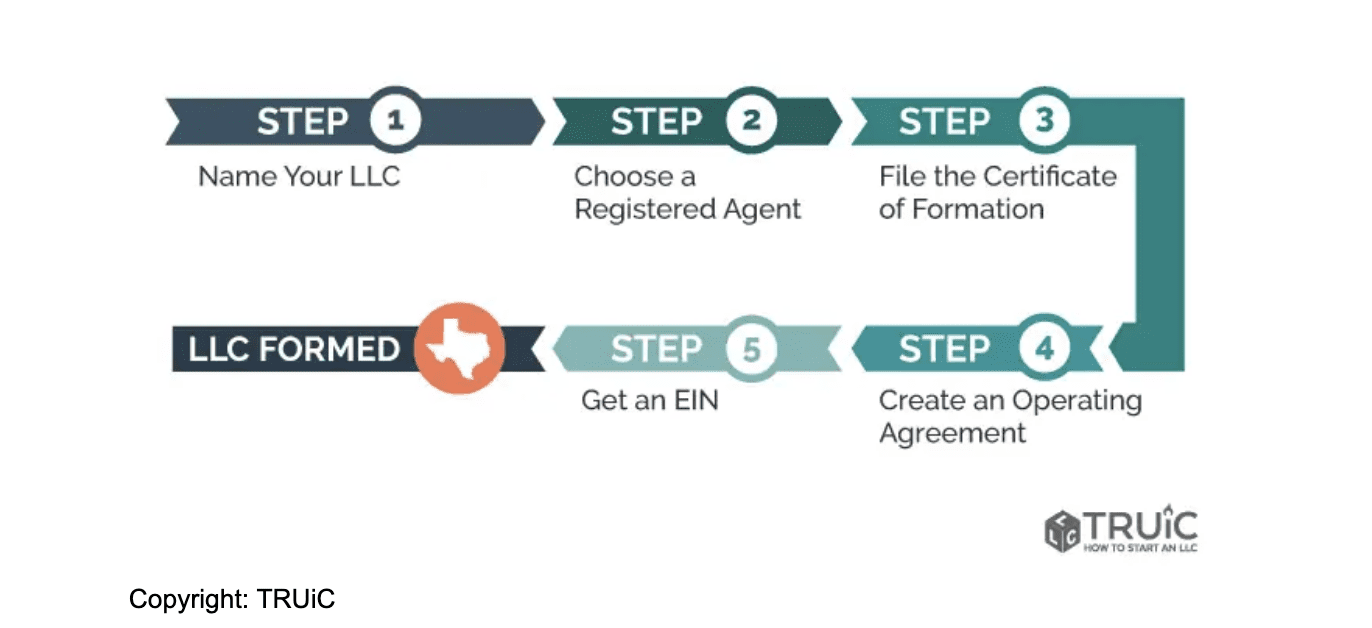
To start an LLC in Texas, entrepreneurs will be required to file the Certificate of Formation via the Texas Secretary of State– with a filing fee of $300. Applications can be processed either online or by mail. The Certificate of Formation is the legal document that makes the LLC an official business entity in Texas. The entire formation process can be broken down into five necessary steps:
- Name the Texas LLC
- Choose a Registered Agent in Texas
- File the Texas Certificate of Formation
- Create an Operating Agreement
- Get an EIN
Final Thoughts
The covid-19 pandemic had forced a global paradigm shift; while larger businesses were scaling down, entrepreneurs took the chance to start up their own ventures. Starting a new business takes a great deal of determination, countless hours of hard work, and a decent amount of resilience, the feeling of accomplishment often is the motivation that allows entrepreneurs to keep the ball rolling.
Working remotely wasn’t an option for organizations that could allow employees to conduct their duties outside of the office. Working from home was necessary when cities throughout the world shut down after the pandemic hit. Here I am going to show you remote work trends in 2022.
Remote Work Trends in 2022
As life restarts and businesses reopen, there is finally a light at the end of the tunnel, but many employees who have become accustomed to remote working are left in the dark. Has the world of work been altered forever? Let’s have a look at some of the forecasts for the future of remote work.
Remote Employment Isn’t Going Anywhere
As we adapt to a post-pandemic lifestyle, the first truth that businesses and employees must recognize is that remote work will not go away. While it may not be as prevalent as it was during the peak of the shutdowns, it will remain a common and popular work arrangement.
As our economy changes and the way we work evolves, there’s been a lot of talk about the future of remote employment. Furthermore, there has surely been an increase in remote job searches.
According to a study by SHRM, One-third of workers say they would not want to work for a company that required them to be onsite in a physical office full-time. Organizations that want to attract and keep top talent will need to emphasize remote work, and other employers will be forced to follow suit in order to stay competitive.
Businesses Will Adopt a Hybrid Work Approach
Will businesses abandon their office space in favor of purely remote teams? Not quite, although several well-known corporations have done so. Employers are more inclined to use a more flexible approach, known as the hybrid model.
Rather than forcing employees to choose between working remotely or in an office, a hybrid approach allows people to choose the work location that best suits them, with the understanding that it may change. They can choose to work from home a few days a week or occasionally from the office. It is not rigid and allows for a great deal of flexibility.
As a result, many companies are pursuing a hybrid strategy, with companies such as Ford and Spotify already implementing it. Nine out of ten executives see a hybrid approach as the way forward. Employees appear to agree, with many indicating they’d prefer employers embrace a more flexible working model following the pandemic.
The Number of Digital Nomads Will Increase
While remote work may conjure images of working from a home office or even the couch, many professionals have higher aspirations. Widespread and long-term lockdowns have sparked wanderlust, which led to an increase in the number of people who identify as digital nomads, people who travel and work remotely from various locations regularly.
You may not be able to video call your remote team from the comfort of your own home in the post-COVID era. One coworker may connect from a Vermont wood cabin, while another may connect from a coffee shop in Spain. This flexibility has led to an increase in remote work jobs and occupations such as software developers, writers, web developers, data scientists, digital marketers, and more,
Businesses Will Spend Money on the Correct Tools and Training
Working from home isn’t a fad. Companies that previously viewed it as a temporary stumbling block are now understanding that it is something they must embrace on a long-term basis.
When employees claim they’re unhappy at work because of outdated technology, it all starts with ensuring that their teams have the proper tools to communicate and cooperate effortlessly, both asynchronously and in real time.
We’re sure we’ll see companies abandon clunky workarounds and inefficient processes in favor of setting up tech-savvy systems that are remote-friendly, from project management platforms and goal dashboards to instant messaging tools and virtual meeting solutions.
Businesses will also invest time and money in training managers and leaders in charge of distributed teams and departments. Employees can attend coding boot camps to learn skills that will help them perform their jobs more effectively.
Leaders will need the right tools and knowledge to handle remote onboarding and then successfully manage, inspire, and monitor their direct reports as remote work becomes the norm.
What Does the Future of Work Have in Store for Us?
Unless you have a crystal ball, predicting what’s coming down the pike is tough. After all, most of us are unlikely to have seen the huge curve balls that have been thrown our way during the last year or two.
However, studies and expert projections indicate a future in which the focus is on what work is done, rather than where or when it is done. That isn’t only a change in logistics. It’s a cultural shift for many firms that will prioritize results over hours, and employee productivity over whereabouts.
Do remote jobs do background checks
Yes, remote jobs do background checks. This is because employers want to make sure that their employees are safe and trustworthy. Background checks help to ensure that an employee does not have a criminal record or a history of bad behavior.
Article by: Elizabeth Mackenzie / Founder and CEO / https://www.globalprassociates.com
Do you want to get a loan, then you are at the right place. Keep reading if you want to know 7 VA Loan Tips for Veterans…
Homebuying Process: Getting Approved for VA Loan
One standout benefit of serving in the military, National Guard, or Reserves is your qualification to apply for a VA mortgage. Administered through a broad range of lending institutions, VA loans are guaranteed by the federal government. That’s why they usually feature lower interest rates and more flexible qualification standards. Many service members buy their homes through the VA with no money down. Overall, lenders consider VA loans less risky than conventional private mortgages.
To be eligible for a VA loan, you need to be an active or former member of the military. In general, you must have been honorably discharged, although there are rare exceptions to that rule. Additionally, surviving spouses of veterans can also apply for a VA loan unless they have been remarried. Depending on when you served and why you were discharged, there are service benchmarks you must meet in terms of time served. But to be clear just because you qualify to apply for a VA mortgage, doesn’t necessarily mean you’ll be able to secure one. Here are several tips for increasing your chances of being approved to take advantage of this useful benefit.
Don’t Let the Paperwork Get to You
Applying for any mortgage can be confusing and time-consuming. But VA loans come with an additional layer of complexity. Anything involving the government comes with red tape, right? First, you’ll need to secure a Certificate of Eligibility to be approved for a VA loan, which involves gathering a little more documentation than you would need to apply for a conventional loan. But you don’t need to have a certificate to begin the VA loan application process. In fact, most lenders will be glad to assist you in getting one. Remember that lenders want your business. And a good one will bend over backwards to get it.
Your New Home Must Be Eligible, Too
Here’s why working with a VA loan-savvy realtor can be a tremendous boon. The last thing you want to do is spend lots of time trying to purchase a property that won’t qualify for a mortgage in the end. The government doesn’t want to invest in properties that have major defects and neither do you. They’ve established a set of Minimum Property Requirements for homes purchased under the VA loan program. Your realtor or lender can explain these to you and help you steer clear of properties that don’t stack up to VA standards.
Get Familiar with Acceptable Use and Occupancy Guidelines
VA loans aren’t made for every type of property. Loans are only written for primary residences. Your new home can be a Colonial, a condo, a manufactured home, or anywhere in between but you have to live there. You can even take out a loan to build a home from scratch. But vacation homes and investment properties aren’t eligible for VA financing. In addition, the VA sets time limits around occupancy. Generally, you must move into your home within 60 days of closing. If you’re currently deployed, that rule can be challenging. A spouse can substitute for a deployed service member to meet the occupancy date, but single people may have a harder time fulfilling the requirement. It can be done, though.
Your Credit Does Count
One important advantage VA loans have over traditional mortgages is that VA borrowers are subject to more lenient financial qualifications. Officially, there is no credit score bar you have to clear before you can be approved for a VA mortgage. But having good-to-excellent credit can help you secure a larger loan and/or a better interest rate.
Even a quarter-point difference in the interest rate you’re offered can amount to thousands of dollars over the life of your mortgage. That’s why getting your credit in the best possible shape before you apply for a loan is essential. Download a free copy of your credit report from each of the three credit reporting bureaus to see where you stand. Then do whatever credit repair that needs to be done. Make sure all of your credit accounts are current—and stay that way—while you’re applying for a mortgage. Close any accounts that you’re no longer using. If you find any negative remarks on your report that aren’t legitimate, dispute them. Fixing mistakes on your credit report can take some time. So be sure you attend to your credit well in advance of submitting a loan application.
Remember to Get Pre-Qualified Before You Start House Hunting
Today’s real estate market is very competitive. Nowadays, home sellers are inundated with offers and 43% accept one within a week of listing their homes. Sellers aren’t interested in wasting time and want to talk to serious buyers only. Prequalifying for a loan through one or more lenders—that is, securing a letter that states how much money a lender would be likely to loan you and at what interest rate—is one way to show home sellers that it’s worth their time to work with you. Many home sellers won’t even entertain offers from buyers who aren’t prequalified.
Getting pre-qualified also can help you set home price parameters for yourself and hone in on properties you can reasonably afford. It’s easy to do. And it won’t affect your credit score, even if you prequalify with more than one lender. As someone who has served our country, you’re entitled to the rewards a VA mortgage can provide. And you’re entitled to great service from the professionals you work with during the home-buying process.